

Minggu, 28 Maret 2010
Virtual Vacation: Edinburgh

Senin, 02 November 2009
Trip Recap: Miami
Jumat, 05 Juni 2009
Vacationing and The g.
Sabtu, 14 Maret 2009
Palm Springs Images and the Colony Palms Hotel
 These are a few of my favourite pictures from my visit to Palm Springs. The weather was dry and warm. The Moroccan-inspired Colony Palms Hotel is an old landmark in Palm Springs that is a favourite spot for those who 'don't necessarily want to be seen'. It has been on the Condé Nast Traveller Hot List 2008 — 2009. The pool side bar-restaurant Purple Palm is the discrete meeting spot for locals and Hollywood's music and movie-industry elite.


This is the lucky Buddha at the Colony Palms. Legend has it that if you make a wish while rubbing his tummy your wish will be granted. My friends Sara and Paul from Vancouver were staying at the Colony Palms Hotel, which just happened to coincide with my visit. (PS.....I have gotten my wish!!!!!)

A view through the palm to the discreet and trendy poolside Purple Palm bar.


Shadow cast by cactus on the desert sand

View towards Palm Springs from the lookout point on Highway 74

Palm Springs Wind Energy - Increasingly popular as alternative sources of energy, wind turbine generators are a type of windmill that produces electricity by harnessing the wind. Wind turbine generators are much less harmful to the environment than burning fossil fuels, but they do require average wind speeds of at least 21 km/h (13 mph). The largest of these windmills stands 150 feet tall with blades half the legend of a football field. Windmill farms on the San Gorgonio Mountain Pass in the San Bernadino Mountains contains more than 4000 separate windmills and provides enough electricity to power Palm Springs and the entire Coachella Valley.
Other travel posts you might like:
Travel Blog: Drinks at the Viceroy Palm Springs
Sunday in Milan
VENICE - Bauer Palladio Hotel & Spa, Giudecca Island, Redentore
ROME - Hotel Mascagni, Trevi Fountain, Spanish Steps, Piazza Barberini
FLORENCE - Hotel Santa Maria Novella, Uffizi, Accademia Gallery
Patricia Gray writes about 'WHAT'S HOT 'in the world of Interior Design, new and emerging trends, modern design, architecture,
and travel, as well as how your surroundings can influence the world around you.
© Patricia Gray Interior Design Blog, 2009
Rabu, 11 Maret 2009
Drinks at the Viceroy Palm Springs Hotel
My recent trip to Palm Springs was filled with excitement and one of the things on my list to see was The Viceroy Palm Springs Hotel . It was a glamorous Hollywood hideaway back in the 1930s and was refurbished 4 years ago by Kelly Wearstler of KWID Design Group into a sleek boutique Hotel. Clark Gable, Bing Crosby, Joan Crawford, and 32nd President Franklin Delano Roosevelt are a few of the famous past guests that frequented it. The Viceroy Palm Springs has gotten some great reviews and lately some not so great reviews. But I am only going to focus on my good review. It was a perfect afternoon. I was being driven around Palm Springs by my Dad on an Architectural tour of Screen Block Houses. And after a full afternoon we headed to the Viceroy Palm Springs to arrive just in time for our pre-dinner, late afternoon cocktail. I toured the grounds and snapped some pictures while the cocktails were being stirred and shaken.

Viceroy Palm Springs Hotel
We had a hard time finding the Viceroy Palm Springs Hotel as it is tucked away; except that after driving back and forth a few times I glanced up and saw Kelly Wearstler's iconic white porcelain dog statue on a balcony and bingo we were in.


Viceroy Palm Springs Hotel
The Koi greeted us just inside the shady entrance courtyard. It was very inviting, much like entering a private home.

Viceroy Palm Springs Hotel
The grounds of the Viceroy Palm Springs, house several private Villas dating from the 30's. They had been updated by Kelly Wearstler with black & white awnings, draped verandas, front doors painted orange with shiny new polished chrome hardware.

Viceroy Palm Springs Hotel

Viceroy Palm Springs Hotel
The brick chimneys on some of the Villas had been painted black to match the awnings and a large white medallion was surface applied.

Viceroy Palm Springs Hotel
The Villas faced onto a central courtyard complete with a beautiful cabana with a pool in the rear.

Viceroy Palm Springs Hotel

Viceroy Palm Springs Hotel
The Hotel was decorated in Yellow, White, Black, and Gray. The only deviation from this scheme was the orange front doors on the Villas

Viceroy Palm Springs Hotel
Beyond the pool to the rear of the property is the spa with massage tables set up inside of draped cabanas

Viceroy Palm Springs Hotel
The outdoor massage tables

Viceroy Palm Springs Hotel

Outdoor Showers Viceroy Palm Springs Hotel

The Citron Dining Room Viceroy Palm Springs Hotel

Outdoor dining for the Citron Viceroy Palm Springs Hotel


Viceroy Palm Springs Hotel
Facing onto the other pool which is behind the Citron Dining Room were outdoor dining cabanas

Dad and Joyce at Viceroy Palm Springs Hotel
My Dad and Joyce patiently waiting for me. Gin and Tonic's were welcome. The sun was low and the purple haze particular to that time of day was casting shadows on the mountains behind the Hotel.

Viceroy Palm Springs Hotel
The sun was creating a halo effect around the palm trees.

Viceroy Palm Springs Hotel
Leaving through the lobby and saying good-bye to the Koi

Viceroy Palm Springs Hotel
A perfect end to a perfect day
Other travel posts you might like:
Palm Springs Modern Architecture and the Use of Screen Block
My Visit to Palm Springs
Drinks at the Viceroy Palm Springs Hotel
Sunday in Milan Venice - The Old and the New
VENICE - Bauer Palladio Hotel & Spa, Giudecca Island, Redentore
ROME - Hotel Mascagni, Trevi Fountain, Spanish Steps, Piazza Barberini
FLORENCE - Hotel Santa Maria Novella, Uffizi, Accademia Gallery
LA, Dallas, and Meeting Joni
Patricia Gray writes about 'WHAT'S HOT 'in the world of Interior Design, new and emerging trends, modern design, architecture,
and travel, as well as how your surroundings can influence the world around you.
© Patricia Gray Interior Design Blog, 2009
Rabu, 27 Agustus 2008
Venice - The Old and The New
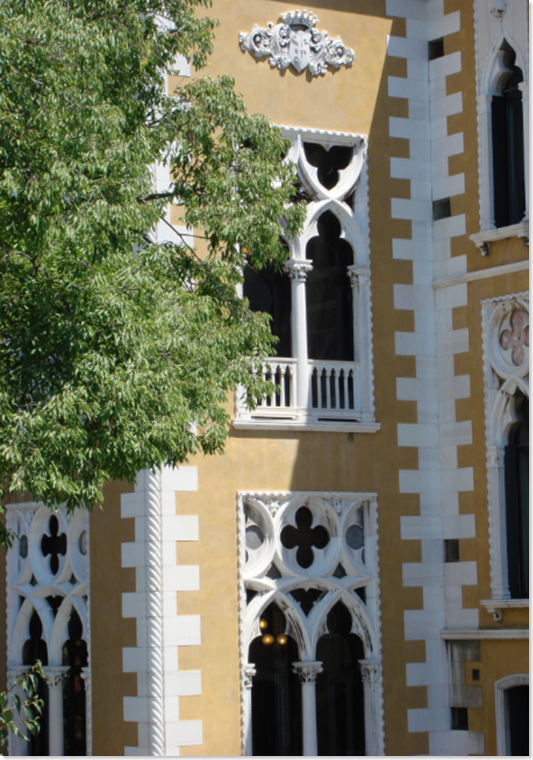
The Old
I just had to share a few examples of the contemporary Architecture in the amazing city of Venice....the city where everyone goes to feast their eyes on antiquity. My visit to Venice was part of a course of study on "Contemporary Italian Architecture". On this visit I had a chance to see a slightly different view of Venice.
The New:
"Casa delle Zattere"
The building below "Casa delle Zattere" was designed in 1953 by architect Ignazio Gardella. Building a new structure in Venice has always presented a stylistic dilemma; how could one ever hope to design a modern building that was compatible with the prevailing styles.
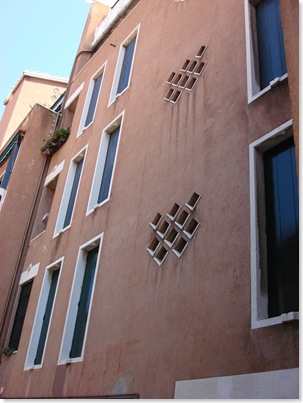
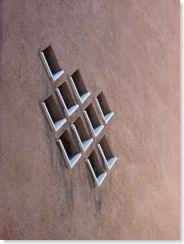
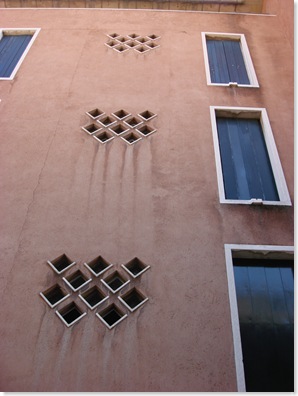
Details of windows of the "Casa delle Zattere"
This design might be thought of as a new gothic palace, a modern building rendered with a veneer of subtle gothicising detail. The stone base, the window frames and sills, balustrades, chimneys, doorways and corners are all designed to make reference to 13th century details and ideas. Along the canal, the 6 story high façade is detailed to fit comfortably with buildings to either side. The traditional Palace elements of base, piano nobile, attic, and roof are expressed within the context of a typical medieval Venetian courtyard house. The Architect, Gardella also used traditional Venetian building materials to help this building blend seamlessly into its surroundings. Today the home is occupied by the Cipriani family of the famed Cipriani Hotel.

Casa delle Zattere as seen from across the canal

This is a detail of the Casa delle Zattere and the adjoining Medieval church. Notice how the cornice details were carried through from the church to the new building, helping the contemporary structure to seamlessly blend to the ancient structure.
Olivetti Showroom
Below are details of the Olivetti Company showroom store designed by Carlo Scarpa 1957-1958 located in San Marco Plaza 101 . Carlo Scarpa paid great attention to detail, often using several different materials simultaneously. He explored tiny universes, studying the relationships among all the elements involved without losing sight of the project as a whole. This store is a virtual feast for the eyes. I could have spent several more hours there discovering all the details. Unfortunately I wasn't allowed to take pictures, but just happened to snap these from the outside. The store has been sold and is now occupied by an Art Gallery. It is a shame because they haven't done much to preserve the integrity of the original design. But it was still very worthwhile to visit and I found it very inspiring. Olivetti was very good in sponsoring and fostering the arts and were ahead of their time in being innovative.


Close-up of the hand laid mosaic floor made of Murrine. Murrine are sliced pieces of candle-layered Murano-glass
used to make the internal ornamentation of millefiori glass-paperweights."


Left Window detail in brass Brass / Right Fountain detail
Querini Stampalia Garden
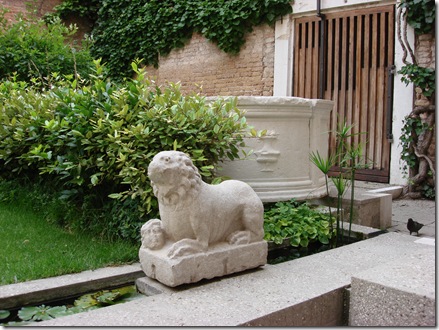
Carlo Scarpa (1906-1978) is an architect whose development draws on deep roots in the Veneto region, and on traditional forms and construction methods. He is the same architect that designed the Olivetti Showroom above. Galleria Querini Stampalia, (1961-1963) is the restoration of the ground-floor of an old Venetian palace with the integration of a garden that is used as a gallery and exhibition space. Again, as in the Olivetti showroom, the attention to detail was outstanding. I was fortunate to visit the garden late on a Sunday afternoon and was the only person there. I had the advantage of being able to view the garden in its entirety unobstructed, and plenty of time to savour the details.


The building was a former Palace and this is the entry via Gondola. Scarpa designed the new metal doors.




Hotel Monaco Renovation
I was very excited to see the new renovation of the Hotel Monaco as there has been some controversy surrounding it. One part of the Hotel remains intact in the traditional decor and the other part, being the entry off the side walkway and the Reception, have a new very glamorous modern look. I found the juxtaposition of the old with the new to be very fresh and well done.


New mosaic panel and large scale lamps. Notice the beautiful terrazzo floors throughout.


Left is a large scale new mosaic panel that serves to separate the new covered interior courtyard from the Reception.
Right The elevator vestibule was a old Venetian canal scene reproduced on glass and backlit.


Stair details


Suite entry doors. The bronze glass door knob was mounted in the center of the door....very cool.


Public washrooms featured these Cararra marble sinks. The taps were motion activated. The Italians do bathrooms like no other country. They are employ more energy efficient techniques than are currently found in North America. For example most taps, even in homes are motion sensor operated. Toilets are dual flush- a small flush or a full flush. Lights are motion sensor operated, they turn on when someone enters the room and turn off when you leave. Paper products in bathrooms are kept to a minimum ( no toilet seat covers and no paper towels).


Left The hotel from the street
Right The Hotel from the Canal

Lobby Chairs covered in Reptile Leather


Right Murano glass ceiling & wall sconces


Table covered in Ostrich skin
Window Shopping
Emilio Pucci, Missoini, Bottega Veneta, Hermes - they are all there.......

You can’t mistake a Pucci print, which is iconically Italian. Since the late-1940s, when Italian skier and socialite Marchese Emilio Pucci casually tried his hand at design, the brand has been synonymous with bold, brightly colored graphic patterns with a kaleidoscopic, slightly psychedelic feel. Pucci prints usually appear on clingy, stretchy fabrics, and are widely applied in every category—evening wear, ready-to-wear, swimwear, accessories, shoes and home décor; they have even been featured in the logo of the Apollo 15 space mission and the interior of a Ford Lincoln Continental. Vintage Pucci is highly collectible, but present designer Christian LaCroix’s more current designs—which use prints from the Pucci archive—are also in high-demand.

Missoni is an Italian fashion house based in Milan. It is famous for its unique knitwear, made from a variety of fabrics in colourful patterns.

Bottega Veneta is a manufacturer of luxury leather goods, most famous for its Intrecciato line of woven leather. The company is based in the Veneto region of northeast Italy. A family firm founded in 1966, Bottega Veneta was bought by Gucci in 2001.


Hermes was showing it's hot, new scarf traveling bag. Bellissimo!!
See other articles on Venice:
VENICE - Bauer Palladio Hotel & Spa, Giudecca Island, Redentore
Venice - Architecture of the 20th Century
Patricia Gray writes about Interior Design inspirations, emerging trends, and the world of Design.
While you're here, subscribe to this feed so you don't miss out.


